Icarus (also known as Ikaros, for the hellenists out there), the bold, the brave, the arrogant. The rebellious teenager who would heed no warnings, and ended up dying from it. The trapped boy who flew too close to the sun, whose ambition got shot down as soon as it took off. It’s a compelling story, at least to me. Who has never dreamt of getting close to the sun, of experiencing the exhilarating bliss of flight at our fingertips ? The myth of Icarus and his demise is usually a popular one, that somehow still resonates with me. Not that I want to do the same as he did. I’ve always entertained the delusion to soar through the skies on my own (planes just aren’t as fun, and I’m quite wary of them), and Icarus does just that, with the help of man-made wings and a lot of recklessness. His tale is full of ups and downs, and a rather fascinating one at that.It underlines the perils that lie behind having too much nerve and pride, all the while offering us a valuable reminder of how ambition can become poisonous, inciting anyone who would listen to nuance and reflexion.
Icarus, the man, the myth, the legend. He was Daedalus’ son, a master craftsman and architect who worked for King Minos of Crete. You might remember this Daedalus as the creator of the Labyrinth in which the Minotaur (son of Minos’ wife, Pasiphaë, and the Cretan Bull, but that’s a story for another time) was trapped. This creature would later be defeated by Theseus. The architect of the maze built such a monstrous structure that it was impossible to get out of (in fact, we still use the word “dédale” in French, from Daedalus, to describe labyrinths). Daedalus, moved by Ariadne (Minos’ daughter), gave her a ball of thread in order to help Theseus (Minos’ enemy and Ariadne’s crush) survive the Labyrinth and triumph over the Minotaur. For this “crime”, both him and his son, Icarus, were sentenced to a recluse (and short) life in the Labyrinth. That’s it for the general context. As the legends go, Daedalus, upon seeing his dearest son’s distress, fashioned two pairs of wings from wax and feathers (because apparently those things are a common resource in a maze), so that they could fly away from Minos’ punishment. Before his son took flight however, Daedalus warned him against the dangers of this newfound practice, inciting him not to stray from the median path : do not fly too close to the sun, nor too close to the water. As Icarus sped away to escape the Labyrinth, he was mesmerised by the sun’s warmth and his newfound ability. Giddy, he soared through the skies, but the heat melted the wax of his wings, and he fell to his death, drowning in the sea below him. After this tragic event, Daedalus mourned the loss of his son, and buried him on the nearest island which now bears his name, Icaria. All this for a ball of yarn. A more historical explanation is given by hellenistic writers, such as Pausanias or Diodorus : Icarus and his father would’ve fled by sea, Daedalus having invented the first sails to flee from Minos’ rowers. Icarus, being a poor sailor, fell overboard and drowned. And honestly, who could blame him ? His dad has ONLY JUST come up with sailing. In both cases, Icarus dies as a consequence of his hubris, or so it seems. For the purposes of this brief exploration, I will rely on the myth, and not on the rational explanation. After all, it is mainly the legendary side of this story that caught my eye.
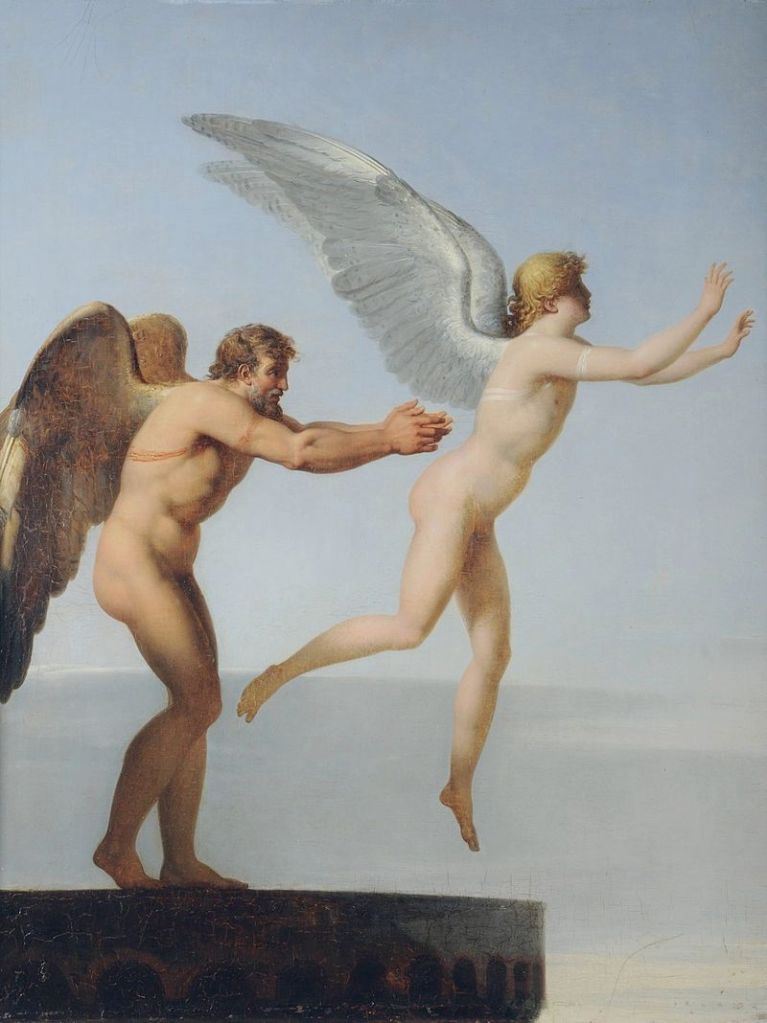
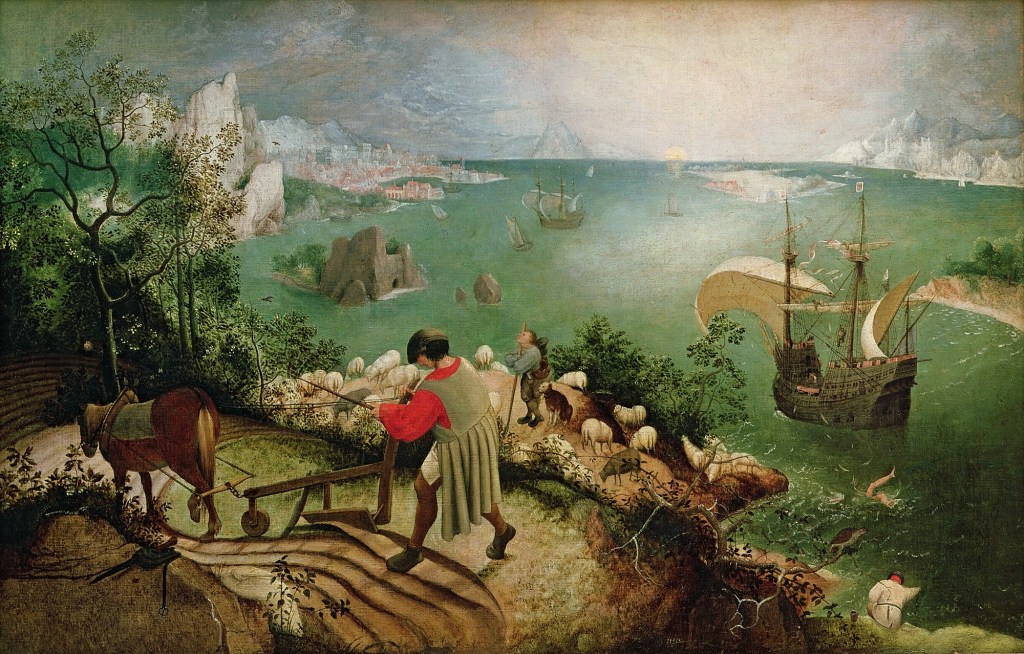
Icarus, the cocky and presumptuous teenager. He did not heed his father’s warning, and died because of it. The different interpretations overlap on this very point : Icarus fell victim to his own youthful hubris and, in a way, got only what was coming for him, because he wanted to fly too close to the sun. Nowadays, we still understand the myth that way, but was Icarus just a snotty child who tried to surpass nature, at his demise ? It’s a story of high-flying ambition and desperate consequences, to such extent that we still use the idiom “don’t fly too close to the sun”. Icarus fell into the trap of ambitious thrill-seeking, and his story acts as an ominous reminder against the perils of having too much pride or arrogance. Furthermore, what makes this myth so tragic is its kind of background position (an example of this is found in one of Bruegel’s paintings, which I have added just below) compared to the bigger myths that surround him, like Ariadne, the Minotaur or Theseus’ legends. Icarus is a passive element in his own story, an unheard voice, up until the moment he actually takes flight. He was once only perceived as Daedalus’ son, and becomes free for the first time ever, as well as master of his own destiny ; it’s no wonder he flies too high and burns like a crisp. The fact that he is immediately drawn to seeking the exhilaration of challenging the sun itself is a reminder that he was young and childish. Icarus was the first human to fly, unassisted, by flapping his own arms up and down, but didn’t have the hindsight or humility necessary to come back down in one piece. This story is but a tragic ballad, drenched in blue skies and dark horizons, that recounts the rise and fall of the boy who wanted to touch the sun, overwhelmed by the drunken soberness of eagerness and excess.
Icarus, the wildcard, the ambitious, the bubbly and unpredictable force of nature. The way he is treated by history feels unjust, in my opinion. Sure, he was arrogant, but who isn’t, at that age ? He symbolises a sort of “born to be wild” feel, to me. If I were so bold, I would say that Icarus could be considered as collateral damage of circumstances over which he had no power. He follows his father’s footsteps, Daedalus himself being an active contributor to his demise. Icarus is trapped in the Labyrinth because of Daedalus’ successive betrayals against Crete, and dies because of his father’s ingenuity. He doesn’t have anything to do with his own imprisonment, and loses his life whilst trying to escape an unfair sentence. The real “enemy” here (as defined by someone who is hostile to someone else, and tries to actively harm them) is King Minos, who, on a powertrip, decided that he could legitimately control everything around him(even if he is King, that does not justify everything), and caused Icarus’ collapse. The latter falls victim to the circumstances of his birth and his own father’s (more or less) bad choices. Icarus’ arrogance has nothing to do with this in particular ; it is rather Minos’ hubris (his greed and pride angered the gods, especially Poseidon, who instigated the Minotaur’s existence as punishment) that triggers his decline. Icarus was arrogant, yes, but he also was an unwilling part of something that was so much bigger than him. And even if he had flown lower, he would not have been saved. When Daedalus warned him, earlier on, he made sure to mention that flying low, whilst seeming like the best choice, was deceptively safe. The water and the humidity would’ve stuck to Icarus’ wings, making him too heavy to fly. Icarus made a choice : he went as high as he possibly could, instead of sinking into the depths of oblivion. He became a ball of flames shooting across the sky, smiling and laughing as he goes down : what a thrill it must be, to be at the center of a world on fire !
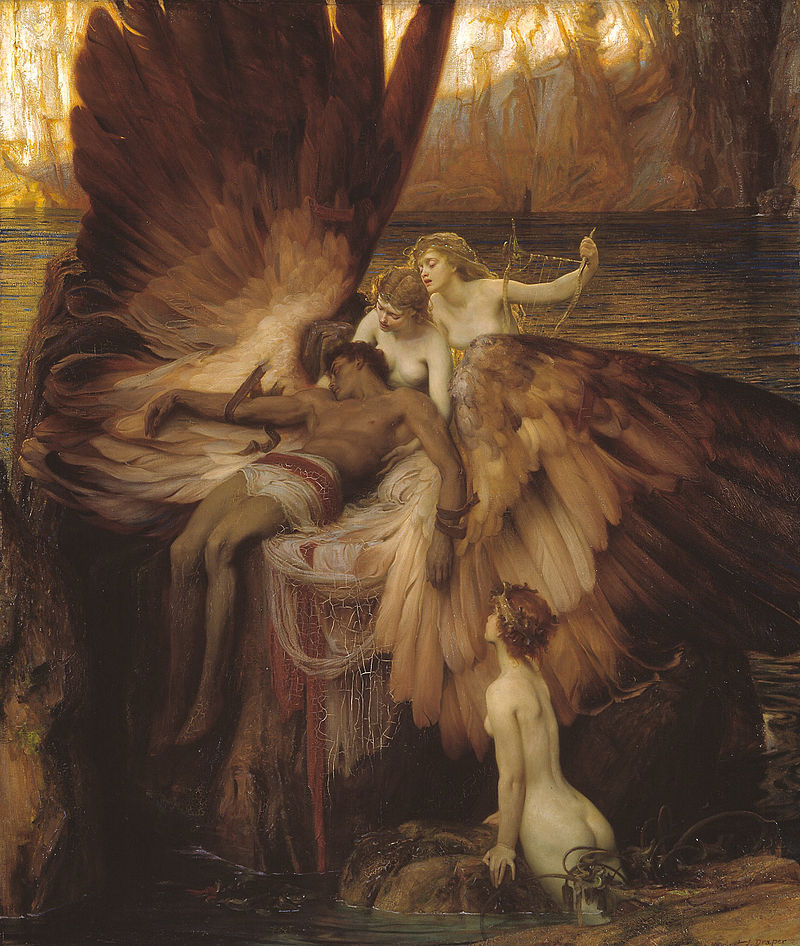
Icarus the broken, the thrill-seeker, the unbalanced. Like a moth to a flame, he burned his wings against a fire he wouldn’t turn away from. His myth may not be the only story of narcissism and playing with fire (Narcissus and Echo being the most popular ones, but it’s still an effective and compelling warning against those things. Icarus died at the hands of hubris, of an arrogance he could have escaped, even if he was pushed to it by external forces. But by cruising too low, and not pushing himself enough, Icarus would’ve met an equally jarring and terrible fate by sticking to a fierce and perilous sea. It’s a question of balance, of finding the right path to engage in, whether it be soaring through cyan skies and fluffy clouds, or skimming the surface of freezing, undisturbed waters.Ambition can’t be left unchecked, otherwise it will fall prey to itself, sure. But being complacent, staying too close to safety, not having any ambition, isn’t the answer either. If Icarus had taken a step back to take everything in, and calmed down, he might’ve been able to live longer. So yes, a little bit of everything in moderation is the way to go. I find consolation in a few verses from Ovid’s Metamorphoses, in which the Latin poet evokes the Icarus and his father’s flight. Through the eyes of a passing fisherman or a simple shepherd, Daedalus and his son become akin to gods, cementing their prowess into their minds. They are witnessing a tragedy they know nothing of, but cannot help but marvel at their sight.
Hos aliquis tremula dum captat harundine pisces,
aut pastor baculo stiuaue innixus arator
uidit et obstipuit, quique aethera carpere possent,
credidit esse deos.
Beneath their flight, the fisherman while casting his long rod, or the tired shepherd leaning on his crook, or the rough plowman as he raised his eyes, astonished might observe them on the wing, and worship them as Gods.


 background character
Leave a comment